Five strings?
Instruments- discuss specific features, luthiers, instrument problems & questions
Steven, that is similar to the 6 strings I am asked to build at times. The only difference is a single vs. double middle string.
Steven, that is similar to the 6 strings I am asked to build at times. The only difference is a single vs. double middle string.
Bill Berg makes 5-string dulcimers with an interesting set-up...doubled melody strings, single middle, doubled bass tuned an octave apart...makes for a fuller sound, not necessarily louder. I love mine; one of my favorites. I equally love my 3 and 4 string dulcimers. I can only speculate (which I won't do here) why a luthier would insist a beginner buy a 5-string, though.

Bosse (She's a girl, but has a male name. Ask my daughter why.) She's a "dvärgvädur," which seems hard to translate. Maybe Mini Lop, Hollad Lop, Dwarf Lop.
She's normally in my daughter's room (we live in an apartment), but every summer she gets to spend some time outdoors at grandma and grandpa's in southern Sweden.
All I found was this old listing on Reverb:
https://reverb.com/item/6939411-music-crafts-mountain-music-dulcimer-4 string-vintage
It probably looks like yours. No date given, but the same labeling.
I've done a bit of looking in Jean Ritchie's Dulcimer People and not found a maker working under that label name.
I think I find the song below mournful, because the words all sound beautiful, though the tune is very haunting, then at the end it says all this will be "When you lie still."
The World Is Old Tonight, The Morning Dew
Traditional shepherd’s carol from the Ritchie Family, Traditional Irish Reel
The world is old tonight, the world is old
The stars around the fold do show their light Do show their light
And so they did and so, a thousand years ago And so we’ll do, my love, when we lie cold
The world is still tonight, the world is still The snow on vale and hill like wool lies white Like wool lies white
And so it did and so, a thousand years ago And so we’ll do, my love, when we lie still
Bit of a postscript here. I had heard of the title "Little Musgrave", but that's about it. This is one wicked little song. Yes, it ends as unhappily as Child Ballads have a nasty tendency to do (are there any happy ones?), but the action is far from slow and I think our Strumelia would agree this one ought to hold the audience's interest. I'll prowl the verses to get it as lean as possible.
WOW! I just went to YouTube and caught Nic Jones's fingerstyle guitar version. Oh Ken, that's one heck of a rockin' Child's ballad. I know for a fact they plan to bring the theme of Child's Ballads back next year and I was dreading a real downer of an evening. The librarian in me will research the heck out of this song, but I'd thank ye kindly for any arrangement, or whatever you might be willing to send my way. I know I could probably manage it on guitar, but I'd love to do it on the dulcimer.
Dusty Turtle is right. (And if you have never tried playing in DAG, it is interesting!)
I think we hear both Aeolian and Dorian modes as "minor" because in both, the 3rd note of the scale (the third scale degree, in theory talk) is a minor third (3 semitones) above the key note (root). (This is the F natural at the 3rd fret in DAc.)
Aeolian is the "natural" minor scale. Dorian is a little "brighter" because it has a raised 6th note. If your instrument has a 6+ (6 1/2) fret, you can hear the difference. Here's how:
If you play in DAc using the 6 fret, the melody string(s) give D Aeolian. Starting with the open string (C) and going up to the 8th fret (skipping 6+) you get: C D E F G A Bb C D
DAc using the 6+ fret gives D Dorian: C D E F G A B C D
In arrangements of Dorian melodies in D, you often hear the B natural harmonized with a G major chord (ex.: 7-6-6+ or 3-3-6+), which can be a nice contrast to the minor harmony implied by the F natural.
Hope that illuminates - TomR
Lois -- check out the olde version of Shady Grove, called Little Musgrave. No spooky or lonesome but a great "origin story". I often perform Musgrave and then explain how lyrics and tunes change over hundreds of years.
I'd post The 3 Ravens, but if you read my update on how my performance went, I'm not sure I'm ready to go back to it for a lo-o-o-o-ng while.
I do play Shady Grove and it has a few mournful verses, but the tune is bouncy.
Sally Ann Watches a Movie for Cats (with a couple replicas of vintage instruments in the background)
I probably have about three hundred favorites! Yet I'll name three here. :)
And Can It Be - Charles Wesley
Peace Train - Cat Stevens (Yusuf Islam)
Hard Times Come Again No More - Stephen Foster
The vast majority of the revival and pre-Revival instruments had only 3 courses of single strings -- melody, middle drone and bass. But pre-Revival luthiers experimented will all sorts of numbers of strings.
The 4 string, doubled melody course was popularized in the Revival as a way to get more melody volume compared to the mid and bass drones.
The 5 string, with two doubled course pretty much came from the same era. They are not common in the dulcimer world today, but not unknown, either. The idea that all dulcimers must have 5 strings is ludicrous at best.
6 strings -- all courses doubled -- were known a "church" dulcimers. The idea being that they had enough volume to be the instrument for services in one-room, backwoods, churches.
Scheitholtz and similar fretted zithers of early America and Europe had as many 16 strings arranged in double, triple and quadruple string courses, as can be seen in the University of Leipzig Instrument collection on-line.
Obviously, all dulcimers do not need to have five strings. Five strings are not unusual, but dulcimers typically had three strings in the latter half of the 19th century as evidenced by the surviving dulcimers of James Edward "Uncle Ed" Thomas, Charles Napoleon Prichard, and others. At some point, a four string (double melody) set-up became the standard. Individual dulcimer makers have experimented with the design of the dulcimer and other variations of the dulcimer (Scheitholt, Epinette des Vosges, Langspil, Langeleik, Hummel, Hungarian Citera, Pennsylvania Dutch Zitters, etc.) exist with more or less than today's standard of three or four strings. The luthier that stated all dulcimers must have five strings is only stating his personal preferences. Plenty of evidence exists to prove that dulcimers can and do come with a varying number of strings. The dulcimer is a folk instrument. The number of strings is entirely up to each individual to decide for himself or herself.
There are some dulcimer makers whose standard models feature five strings. I can think of a few. But there is no standard in which the number of strings defines what is and what is not a dulcimer. If someone wants a five string dulcimer, by all means purchase one.
By the way I also have a Blue Lion AJ baritone dulcimer. I ordered it with just three tuners and three strings and Bob and Juanita Baker were very accommodating. Their dulcimers are in high demand these days, and anyone ordering a Blue Lion can expect a considerable wait.
James Horner's The Ludlows from Legend of the Fall
I wish I could find a way to tab this song.
Hmmm....dulcimer tabbed songs, Going Home, Somewhere over the rainbow, Summertime
I have a Blue Lion AJ 5 string. It came with 5 separate strings [5 tuning machines]. The strings were too close together for my fingers so I removed 2 of them and converted it to a 3 string bass which I play when I'm not using the Folkcraft resonator. I've seen 1-2 with doubled bass and melody strings also. I don't think I would use one although they may be great for noter/drone players, more volume probably.
I just had a couple of friends come over for some look-see at my dulcimers and to discuss playing. She had two dulcimers she had purchased when she first wanted to learn. I won't name the brand but the luthier told her that ALL dulcimers should be five strings. He was adamant about this and when I expressed surprise, the person with her stressed the luthier had a reputation and that he knew what he was talking about.
This led me to wonder. I've been playing for four years. Every friend I know who plays, buys a dulcimer which often comes with four strings, removes the fourth melody string, then goes on playing with three strings.
I have honestly never seen a five string dulcimer and was kind of surprised this luthier stressed this to her... a new player.
Do yall ever see five strings? Why would he have said this?
Looks like you got a winner there, Gail!
Enjoy your new dulcimer.
Ken
"The dulcimer sings a sweet song."
Sounds nice Gail- do you have any photos?
I received my newest dulcimer a week ago. It was made by Rick Gooden at New Harmony Dulcimer Company in Indiana. It has a beautiful walnut back and sides, swamp ash top, Brazilian rosewood fretboard and 26" VSL. I'll have to say that if I had to run out of the house with just one, this would be it! It sounds really great on fast fiddle tunes or slower pieces and the workmanship is wonderful.
If you study ukes in their broader aspects, you will find the "D tuning" isn't anything strange.
Generally speaking, British and Canadian players tune A-D-F#-B, and according to some sources, it was popular in Hawaii at one time. It was pretty much standard before WW-II in the USA. Because of that you can readily purchase string sets intended for the higher tuning. Many small tuners even give you a choice between U-C and U-D setups.
I have several "learn ukulele" books, and probably the best of the bunch is Roy Smeck's classic, which is all in D tuning. See https://www.amazon.com/Mel-Bay-Ukulele-Method-Smeck/dp/0871664836 for details.
I keep one (cheap) tenor tuned each way.
David, Sally Ann is such a beautiful can. I know she brings you much joy.
Which model of Dulcimore Dan's is that one? It sure is a nice looking duclimore.
David, Sally Ann looks to be studying how she's going to play with her new acquisition. :)
Here is Sally Ann admiring the new Dulcimore that arrived from Dulcimore Dan this week. The instrument is made pine and cherry. Sally Ann will be a year old on 9 March.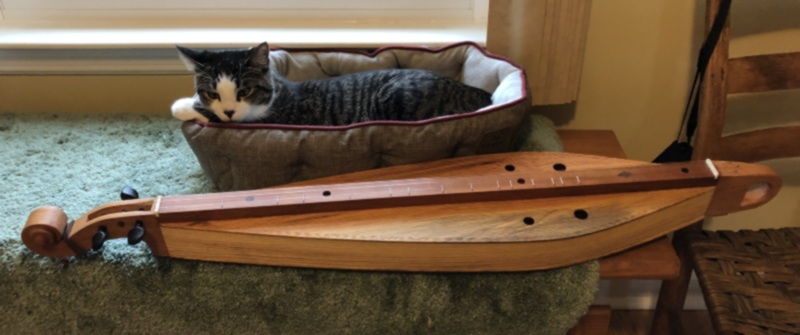
Glad my suggestion worked out. Enjoy your new to you dulcimer.
Ken
"The dulcimer sings a sweet song."
Is the lower string also tuned to D an octave lower than the others? That is certainly a valid dulcimer tuning. It looks like you can easily add a groove in the nut to make it a double melody string. You would then move the other string to the center slot which is already on the nut. Using the proper strings for the vibrating string length of the dulcimer you could certainly tune to DAA or DAd.
Ken
"The dulcimer sings a sweet song."
Thanks Ken. I took your suggestion. I added a groove in the nut and and made a double melody string. I moved the middle string to the center and tuned to DAd. Sounds great!
Ken is right. It looks like the bridge has a groove for a double melody string, so you could make one in the nut and string the dulcimer as a three-course instrument with a double melody string. Or you could just string it as a three string instrument with no double melody. Lots of folks take off that extra string anyway.
You might consider putting on new strings if those on the instrument seem old. I try to change strings every few months.
By the way, this Forum on Site Questions is intended for questions about how the website works. So I've moved this discussion to the Forum for questions on specific instruments and luthiers. It will be easier for others to find that way.
Is the lower string also tuned to D an octave lower than the others? That is certainly a valid dulcimer tuning. It looks like you can easily add a groove in the nut to make it a double melody string. You would then move the other string to the center slot which is already on the nut. Using the proper strings for the vibrating string length of the dulcimer you could certainly tune to DAA or DAd.
Ken
"The dulcimer sings a sweet song."
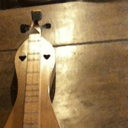
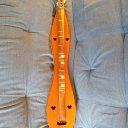
Hi. So I have been interested in getting a mountain dulcimer and found one at a pawn shop yesterday that looked to be decent so I nabbed it. Upon getting it home and looking at some youtube videos I see the set up is different that most of the ones I see. Rather than 2 strings close together for the melody, it has 4 equidistant strings. Right now the 3 top strings are tuned in unison to D. The bottom string is higher gauge and tuned lower. Can anyone tell me how this should be tuned? I ordered another nut that has the 2 melody strings together(haven't received yet) but not sure if I should change it out or get it tuned properly the way it is and play around with it. Any comments/suggestions are welcome.
I picked up a 1977 three string McSpadden M8-W the other day. I had questions about the bridge and about the model number and contacted Jim Woods at The Dulcimer Shoppe for more information. The bridge was cut away under the bass string, and I had not seen very many M8's when I searched on the internet - mostly M12's. Here's what Jim provided regarding the bridge and the model numbers:
"The cut in the bridge was for compensation. The original string set is the same one we sell now as our Ionian set. The strings are all loop end type with the bass string being a wound .022 diameter and the others all .012 plain steel. The tuning would have been either key of C or key of D. For the key of C the bas string would have been tuned to C an octave lower than middle C and the other strings would have been tuned to G five steps higher than the bass. For the key of D they would have been one step higher than that (D bass and As for the others).
The first couple of years there was no real standardization of McSpadden models as they were sort of experimenting and developing their designs and models. When they did standardize, they offered the M8 and M9 hourglass models and T8 and T9 teardrops. The M8 and T8 were a little shallower and narrower than the M9 and T9. All of those were offered both as finished dulcimers and as kits for the customer to build. The design development didn’t stop and the deeper and wider M12 and T34 soon followed. (I don’t know why they chose to not call the teardrop version T12). Most customers preferred the larger models so they eventually phased out the 8s and 9s. I don’t have a date on that but it was late 70s. The current hourglass and teardrop models we make are basically the same size and shape as the M12 and T34. In 2005 we stopped using those designations and started simply calling them hourglass and teardrop."
My M8 is roughly 36" long, lower bout is 5 3/4", upper is 4 1/2", body is 1 3/8" tall, fretboard is 1" tall x 1 1/4" wide.
Picture of the bridge is attached for reference (not sure how to link to my gallery).